
AI First Principles Edition: The Road to Artificial Intelligence
- October 25, 2024
- Posted by: Onassis Nottage
- Categories: AI Decision-making, AI in Ecommerce, AI Solutions for Ecommerce, Data Governance, Data Quality and Compliance, Data Storage and Operations, Data-Driven Business Strategies


The Aiken pyramid is illustrated as a pyramid with five levels, each representing a different aspect of data management, via DMBOK
Introduction
Artificial Intelligence (AI) has revolutionized industries by optimizing network performance, enhancing customer service, and detecting fraud. For this example, we will focus on the ecommerce industry. Here, leveraging AI can mean the difference between leading the market or falling behind. However, choosing the right AI solutions requires a structured approach grounded in first principles. This article explores the dependencies and layers essential for making informed AI decisions, beginning with AI and tracing back to the foundational layer of data governance.
Artificial Intelligence (AI)
Ecommerce companies can deploy various AI solutions to enhance operations. These solutions can include optimizing network performance, improving customer service, and detecting fraudulent activities. The challenge lies in selecting the most suitable AI tool for the company’s specific needs. This decision-making process begins with understanding the company’s requirements and the capabilities of each AI solution. Selecting the most suitable AI tool requires a thorough understanding of the company’s specific needs and the capabilities of various AI solutions.
And so now my question is: How are they going to figure out which AI solution to pick?
Data Science

The Aiken pyramid is illustrated as a pyramid with five levels, each representing a different aspect of data management, via DMBOK
Data science is crucial in aligning AI solutions with the company’s goals. Without proper data science evaluation, the company might choose an AI tool that doesn’t align with its needs, leading to suboptimal performance or even failure in solving the intended problems. Data scientists evaluate different AI tools using algorithms and analytical techniques. They assess how well these tools can meet the company’s needs. However, this assessment relies heavily on the availability and quality of relevant data.
And so now my question is: Where does this data come from?
Data Warehousing & Business Intelligence (BI)

The Aiken pyramid is illustrated as a pyramid with five levels, each representing a different aspect of data management, via DMBOK
Data warehousing involves storing vast amounts of data from various sources like network logs, customer interactions, and billing systems. Business Intelligence (BI) tools analyze this data to generate insights into network performance, customer satisfaction, and operational efficiency. To derive accurate insights, the data must be consistently clean and standardized.
And so now my question is: How does the company achieve this consistency?
Reference & Master Data Management

The Aiken pyramid is illustrated as a pyramid with five levels, each representing a different aspect of data management, via DMBOK
Reference and master data management ensure that the data is accurate and consistent across different systems. Reference data is static data used to categorize other data (e.g., country codes), while master data is critical business data shared across multiple systems (e.g., customer information). If reference and master data management are not implemented, the data in the warehouse might be inconsistent and difficult to analyze, resulting in misleading BI insights and decisions. That being the case, unstructured data like documents and multimedia files also need to be organized and accessible to act as supplementary material for the reports.
And so now my question is: How can we cross-reference these reports with other company documents?
Document & Content Management

The Aiken pyramid is illustrated as a pyramid with five levels, each representing a different aspect of data management, via DMBOK
Document and content management systems handle unstructured data, such as customer emails, network diagrams, and multimedia files. Without document and content management, unstructured data like customer emails and multimedia files may be inaccessible or disorganized, making it difficult to ensure comprehensive and accurate reference and master data. Therefore, systems ensure that unstructured data is organized and accessible. The challenge is combining this unstructured data with structured data for comprehensive analysis.
And so now my question is: How is this integration achieved?
Data Integration & Interoperability

The Aiken pyramid is illustrated as a pyramid with five levels, each representing a different aspect of data management, via DMBOK
Data integration combines data from various sources, such as Customer Relationship Management (CRM) systems, network management tools, and billing platforms. Without data integration, structured and unstructured data remain siloed, preventing a holistic view and analysis, which compromises decision-making and operational efficiency. Interoperability ensures these systems can work together seamlessly.
And so now my question is: Where and how was this data stored and managed efficiently?
Data Storage & Operations

The Aiken pyramid is illustrated as a pyramid with five levels, each representing a different aspect of data management, via DMBOK
Data storage provides the necessary infrastructure for storing and managing data. Without effective data storage and operations, the data required for integration may be disorganized or inaccessible, hindering seamless interoperability and comprehensive analysis. Ensuring that data is organized and accessible is critical for efficient operations.
And so now my question is: How does the company maintain this organization and accessibility?
Data Modeling & Design

The Aiken pyramid is illustrated as a pyramid with five levels, each representing a different aspect of data management, via DMBOK
Data modeling defines the structure of the data, specifying how it is stored, accessed, and managed. Without proper data modeling and design, the storage infrastructure might be inefficient or poorly organized, leading to difficulties in data retrieval and management. This process is crucial for organizing data and facilitating its use, therefore, safeguarding this data from unauthorized access and breaches is equally important.
And so now my question is: How does the company protect its data?
Data Security

The Aiken pyramid is illustrated as a pyramid with five levels, each representing a different aspect of data management, via DMBOK
Data security measures protect data from unauthorized access and breaches. Without data security, the structured data might be vulnerable to unauthorized access and breaches, compromising data integrity and trust. Understanding the context and structure of the data is essential for effective security. This understanding makes data management and utilization easier.
And so now my question is: How does the company ensure the accuracy and reliability of this data?
Metadata

The Aiken pyramid is illustrated as a pyramid with five levels, each representing a different aspect of data management, via DMBOK
Metadata provides detailed information about other data, aiding in its organization and retrieval. Without proper metadata, it becomes challenging to understand the context and structure of the data, making it difficult to implement effective security measures. Accurate, complete, and reliable metadata is crucial for data management.
And so now my question is: How does the company ensure that all this data flows correctly through all systems?
Data Architecture
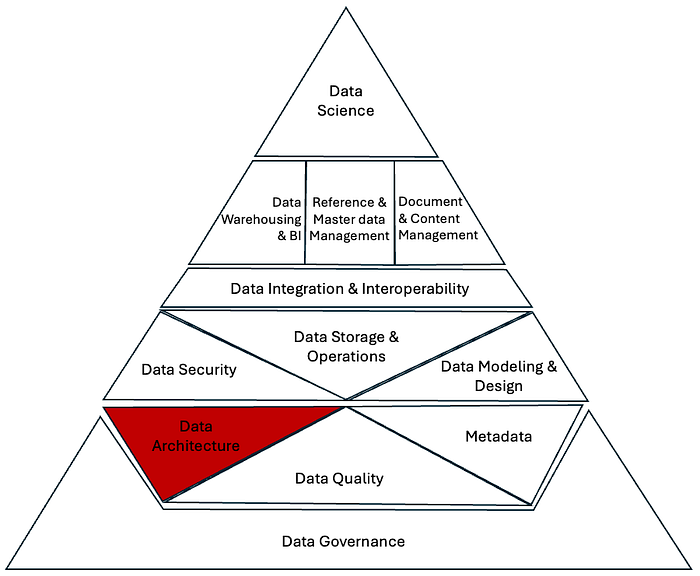
The Aiken pyramid is illustrated as a pyramid with five levels, each representing a different aspect of data management, via DMBOK
Data architecture defines the blueprint for managing data assets. Without a robust data architecture, ensuring the flow and quality of data across systems becomes problematic, leading to inconsistencies and unreliable data. It ensures that data is structured and flows seamlessly across systems.
And so now my question is: How does the company ensure the quality of all this data?
Data Quality

The Aiken pyramid is illustrated as a pyramid with five levels, each representing a different aspect of data management, via DMBOK
Data quality ensures that the data is accurate, complete, and reliable. Without a robust data architecture, ensuring the flow and quality of data across systems becomes problematic, leading to inconsistencies and unreliable data. High-quality data is essential for integration, storage, and analysis, and so compliance with established policies, procedures, and standards is crucial.
And so now my FINAL question is: Who oversees this compliance?
Data Governance

The Aiken pyramid is illustrated as a pyramid with five levels, each representing a different aspect of data management, via DMBOK
Data governance establishes the policies, procedures, and standards for managing data. Without data governance, there would be no structured approach to ensuring data quality, security, and compliance, leading to chaos and inefficiency in all subsequent layers. It ensures that all processes, from data quality and security to metadata and integration, function correctly. Effective data governance provides the framework necessary for maintaining data quality, security, and compliance. It is the foundation upon which all other layers depend, ensuring that every layer performs optimally.
Conclusion
The journey to effective AI implementation in our example industry is intricate, involving multiple interdependent layers. Starting from AI and data science, and moving through data warehousing, management, integration, and security, each layer builds upon the previous one. The foundation of this entire structure is robust data governance. By establishing clear policies, procedures, and standards, data governance ensures that data quality, security, and compliance are maintained, enabling the successful deployment of AI solutions that drive business success. Now scroll up and watch your pyramid get built properly!